NFT Royalties Cannot be Technologically Enforced
Stop holding your breath for tech solutions; the market needs to move on.

The slow and then sudden move to NFT royalty avoidance in the Solana NFT scene was inevitable. Pressures of the bear market and thinner margins were always going to lead here.
Since DeGods moved to 0% royalties and Magic Eden removed royalty enforcement most NFT projects on the chain have dipped hard. ‘A’ did not necessarily cause ‘B’ - we are in a bear market - but it didn’t help. And there were many other factors such as SudoSwap, the Yawwww marketplace, Solanart, the escalation of royalty rates inspiring traders to prefer OTC swaps, etc.
Now many people heavily invested in NFTs are holding their breath for a technical solution to the royalties issue. A bunch of people and projects say they are working on it. The majority seem to accept that royalties for true artists are good and should exist, and most NFT projects would benefit from a “reasonable” transaction fee.
There is no solution coming. I don’t need to be a developer or engineer to know that.
To be more specific, there will be developments but they will all carry tradeoffs that I think the market should and will find unpalatable and unacceptable.
Consider the most fundamental value proposition or use of NFTs: to serve as digital proof of ownership. Ownership and control are the meat and potatoes of the thing. The quintessential NFT is immutable and fully under the control of the holder, in every conceivable way.
On Solana we already make perhaps too many concessions against these fundamental values of ownership and control. We mostly accept the Metaplex standard for NFTs that incorporates mutability via the update authority, allowing someone else to change the most important components of the token at any time like the metadata and associated art. But unless we approve a restriction (like a freeze authority) no other party can stop us from transferring our tokens, selling them where we want, burning them, etc.
Royalties on NFTs have never been technically enforceable, on any blockchain. They merely serve as suggestions, or perhaps components of an implied contract, that NFT marketplaces have chosen to honour, historically. If an NFT royalty were technically enforceable 100% of the time it would logically represent a reduction in the ownership and control that a holder has over the NFT; in the face of a 5% royalty that cannot be avoided can you really say that you own more than 95% of the value of the token? It’s like having a lien on your house. The equity is not 100% yours.
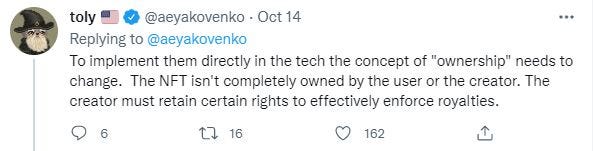
Every conceivable technical solution to the problem of people avoiding NFT royalties would entail a further reduction in ownership and/or control.
Anetoly knows this:
Metaplex knows this:
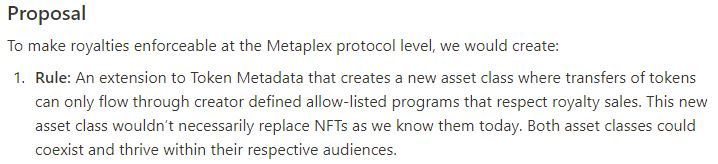
The lower picture is from the Metaplex Foundation’s recent notion paper on the problem. See how their proposal would make basic transfers of an NFT have to flow through approved programs/apps.
You can’t have your NFT cake and it eat it too. You can’t wholly own your digital assets and have hard-coded rights against them owned by non-holders of the asset. There is a logical conflict there that technology cannot solve.
My prediction is that people will make technical solutions but none of them will be widely adopted. It’s simply too much lost to no longer be able to do a basic wallet to self-owned wallet transfer without some form of centralized approval.
I think the solutions to enforcing NFT royalties that have a chance at wide adoption will only be those that do not try to be purely coded solutions. This means policy or community level answers to the issue.
The question builders ask should not be “how can we hard-code royalties” it should instead be “how can we get the majority of people to respect/honour royalties”. Don’t even waste time on the first question.
And focus on answers to the second question that are not punitive; builders should be extremely wary of using the update authority on Solana as a threat against royalty dodgers. I think the market dies if builders of legitimate projects start nuking the NFTs of their holders, for any reason.